


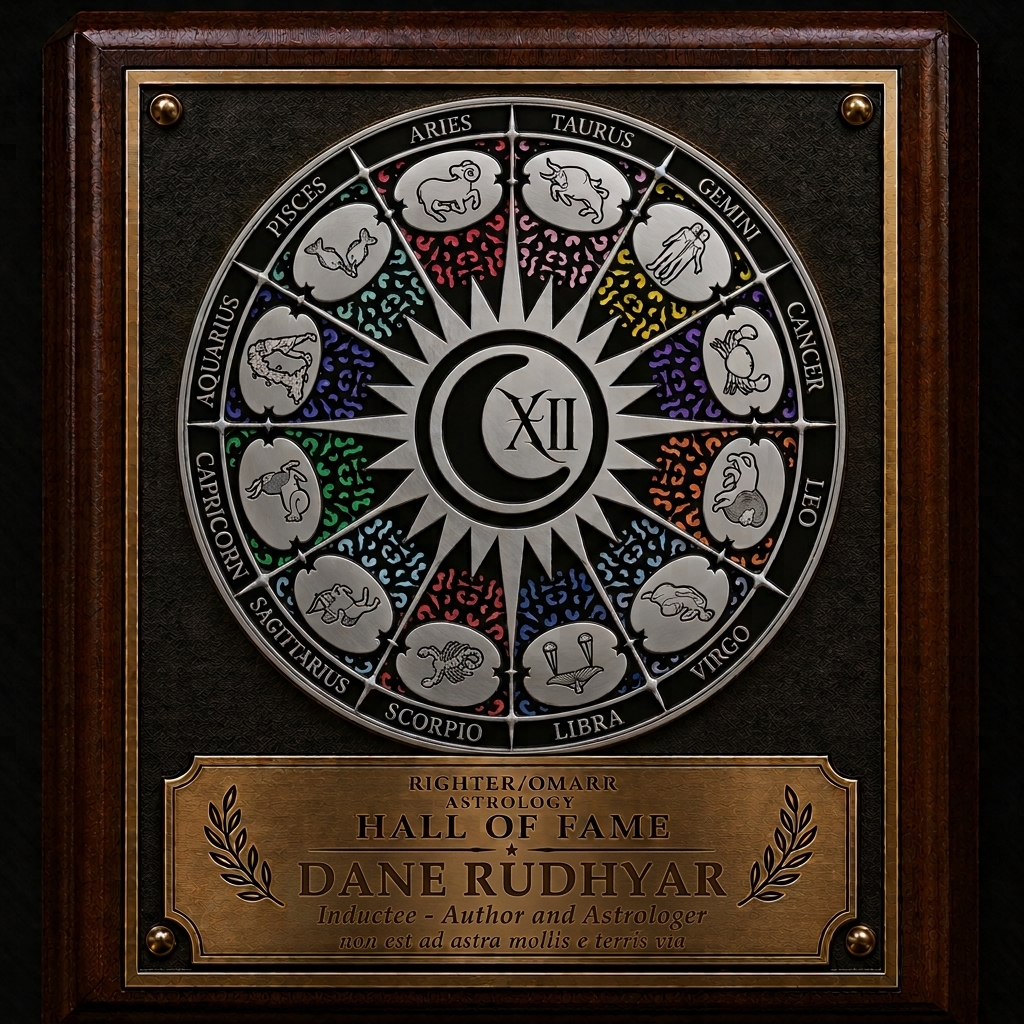
A child piano prodigy, Dane Rudhyar was born Daniel Chennevière in Paris, France. Fresh starts, new beginnings beckoned him and his expanding mind. He set out for New York, and took his name name once he got to the new world. Rudhyar was very aware of the cycles of time, space, and existence and he understood that we are all energy and that the universe itself is a cosmic ocean of energies and synergies, synchronicities, and idiosyncracies. His great discoveries, astute observations, and precise analysis have augmented our understanding and awareness of the cycles at play in the universe, and in our own lives. We salute and commend the lasting, groundbreaking, and remarkable contributions of Dan Rudhya to the ancient art and sceiences of astrology. -Hall of Fame Statement

From the Rudhyar Archival Project:

Part One
The Parisian Years: 1895-1916
DANE RUDHYAR was born Daniel Chennevière, of Celtic and Norman ancestry, on 23 March 1895 in Paris, France. His birth name was given up in 1917, a few months after reaching New York. He had a sister, lost his father in 1911 and his mother in 1954.
Rudhyar began playing piano at age seven, and started composing for the piano in 1912. The surgical removal of a kidney at age thirteen exempted him in 1914 from military service, actually saving his life as the regiment he would have joined was completely wiped out in the 1914 French retreat from the Marne. He received a bachelors degree in philosophy from the Sorbonne at age sixteen.
At age sixteen, Rudhyar first realized two things which conditioned his entire life and work: (1) Time is cyclic, and cyclicity governs civilizations as well as all aspects of existence; (2) Western civilization is coming to what could be symbolically called the autumn phase of its cycle of existence. Such realizations, which were largely spontaneous and intuitive (though influenced by his reading of Nietzsche), made Rudhyar feel the urge to divorce himself from Europe and to seek a “New World” — a land where he could sow himself as a seed, carrying within his being the harvest of whatever was viable and constructive in the European past. The ideal of the “seed man” thus rose in his consciousness, dominating his thinking and his actual living.
His first book, Claude Debussy et son oevre, was published by Durand of Paris in the spring 1913, together with three short piano compositions. The book was intended to be titled Claude Debussy and the Cycle of Musical Civilization, and in addition to biographical information on Debussy it contained Rudhyar’s ideas about time, cycles, and the development of music. However, the publisher deleted the philosophical and historical parts and gave the remaining biographical sketch a new title. For a while he attempted law study, but gave it up, becoming a regular contributor to Le Revue, which, along with looking older than his mere seventeen years, opened many doors for him in the avant-garde world. Later, he acted as secretary to the famous sculptor Auguste Rodin.
In 1913 Rudhyar witnessed the premiere performance of Stravinsky’s Sacre du Printemps. In that year he began an association with two highly creative personalities — Valentine de Saint-Point and a young man named Vivian Postel Du Mas — involved in a futuristic form of multimedia performance art, an abstract synthesis of dance-motion, poetry, music, geometrical form, color and perfume, known as Métachorie (meta dance). A controversial and outspoken personality, Ms. de Saint-Point is today recognized as the prototypical female performance artist.
Rudhyar had written several short orchestral scores, now lost, for Métachorie in 1914 — Trois Poëmes Ironiques and Vision Végétale — and eventually a performance was arranged for New York.
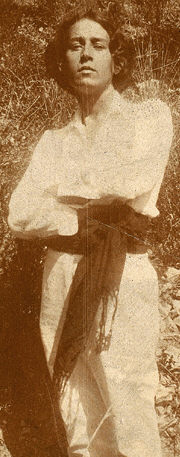
Due to wartime U-boat activity in the North Atlantic, Rudhyar, along with Ms. Saint-Point and Vivian, had to first travel to Spain, where they embarked for New York during November 1916. The photo above shows Rudhyar in Spain while waiting passage to America.
Rudhyar began playing piano at age seven, and started composing for the piano in 1912. The surgical removal of a kidney at age thirteen exempted him in 1914 from military service, actually saving his life as the regiment he would have joined was completely wiped out in the 1914 French retreat from the Marne. He received a bachelors degree in philosophy from the Sorbonne at age sixteen.
At age sixteen, Rudhyar first realized two things which conditioned his entire life and work: (1) Time is cyclic, and cyclicity governs civilizations as well as all aspects of existence; (2) Western civilization is coming to what could be symbolically called the autumn phase of its cycle of existence. Such realizations, which were largely spontaneous and intuitive (though influenced by his reading of Nietzsche), made Rudhyar feel the urge to divorce himself from Europe and to seek a “New World” — a land where he could sow himself as a seed, carrying within his being the harvest of whatever was viable and constructive in the European past. The ideal of the “seed man” thus rose in his consciousness, dominating his thinking and his actual living.
His first book, Claude Debussy et son oevre, was published by Durand of Paris in the spring 1913, together with three short piano compositions. The book was intended to be titled Claude Debussy and the Cycle of Musical Civilization, and in addition to biographical information on Debussy it contained Rudhyar’s ideas about time, cycles, and the development of music. However, the publisher deleted the philosophical and historical parts and gave the remaining biographical sketch a new title. For a while he attempted law study, but gave it up, becoming a regular contributor to Le Revue, which, along with looking older than his mere seventeen years, opened many doors for him in the avant-garde world. Later, he acted as secretary to the famous sculptor Auguste Rodin.
In 1913 Rudhyar witnessed the premiere performance of Stravinsky’s Sacre du Printemps. In that year he began an association with two highly creative personalities — Valentine de Saint-Point and a young man named Vivian Postel Du Mas — involved in a futuristic form of multimedia performance art, an abstract synthesis of dance-motion, poetry, music, geometrical form, color and perfume, known as Métachorie (meta dance). A controversial and outspoken personality, Ms. de Saint-Point is today recognized as the prototypical female performance artist.
Rudhyar had written several short orchestral scores, now lost, for Métachorie in 1914 — Trois Poëmes Ironiques and Vision Végétale — and eventually a performance was arranged for New York.
Due to wartime U-boat activity in the North Atlantic, Rudhyar, along with Ms. Saint-Point and Vivian, had to first travel to Spain, where they embarked for New York during November 1916. The photo above shows Rudhyar in Spain while waiting passage to America.
Read Part Two